Industrial Copper Plating for electrical conductivity and heat treatment stop-off. High-purity MIL-C-14550 compliant finishes for manufacturing.
Copper Plating
- Automotive
- Electronics
- Industrial
- Oil & Gas
- Adhesion
- Aesthetics
- Conductivity
- Heat Dissipation
- Solderability
- Aluminum Alloy
- Aluminum Casting
- Aluminum Forging
- Plastic
- Stainless Steel
- Steel
- Steel Casting
- Zinc Die Cast

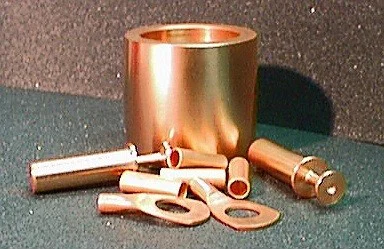
Key Advantages: Conductivity and Masking
Copper is specified not just for its color, but for its unique physical and thermal properties:
Superior Conductivity: Copper is the gold standard for electrical and thermal conductivity. It is essential for components that must carry high current or dissipate heat rapidly.
Ductility (Flexibility): The coating is very “soft” and malleable. If a part needs to be bent or formed after plating, copper will stretch without cracking or peeling.
Heat Treat Masking: In aerospace and automotive manufacturing, copper is used as a “stop-off” mask for selective carburizing. It prevents carbon from hardening specific areas of a steel part (like threads), keeping them “soft” while the rest of the part becomes “hard.”
The Role of Supplemental Coatings
Raw copper reacts quickly with oxygen and skin oils, leading to rapid tarnishing (turning brown or green). To maintain its performance or appearance, it is usually treated with:
Tarnish Inhibitors (Benzotriazole): A chemical dip that creates a microscopic barrier to prevent oxidation without affecting conductivity.
Clear Lacquer/Powder Coat: Used for decorative architectural pieces to lock in the “new penny” shine.
Nickel/Chrome Overlay: Most “chrome” parts are actually a “sandwich” of Copper (for leveling), Nickel (for corrosion), and Chrome (for hardness).
Specifications
Specification |
Comments |
|---|---|
MIL-C-14550 B
| |
Class 0
|
.001 – .005″ for heat treatment stop-off shield
|
Class 1
|
.001″ min. for carburizing shield, decarburizing shield and printed circuit board plated through holes.
|
Class 2
|
.0005″ min. as under coat for nickel and other metals
|
Class 3
|
.0002″ min. to prevent basis metal migration into tin layer to poison solderability
|
Class 4
|
.0001″ min. same as Class 3
|
Industry Applications
Copper plating is a “workhorse” in the electronics, automotive, and heavy machinery industries:
Printed Circuit Boards (PCBs): Copper forms the conductive pathways (traces) that allow modern electronics to function.
Ammunition: Steel-core bullets are often copper-jacketed to reduce friction and barrel wear.
Oil & Gas: Used on the threads of drill pipes to prevent “galling” and seizing under extreme torque.
Grounding Hardware: Bus bars and electrical connectors are copper-plated to ensure low-resistance electrical paths.
Finish Comparison
Copper Plating |
Silver Plating |
Gold Plating | |
|---|---|---|---|
Primary Goal
|
Conductivity / Masking
|
Maximum Conductivity
|
Corrosion-Free Contact
|
Cost
|
Low
|
Moderate
|
High
|
Conductivity
|
Excellent
|
Highest
|
Good
|
Tarnish Resistance
|
Poor (Turns green/brown)
|
Moderate (Turns black)
|
Excellent (Never tarnishes)
|
Main Industry
|
Automotive / Industrial
|
Audio / RF Engineering
|
Aerospace / Medical
|
Copper Plating | |
|---|---|
Primary Goal
|
Conductivity / Masking
|
Cost
|
Low
|
Conductivity
|
Excellent
|
Tarnish Resistance
|
Poor (Turns green/brown)
|
Main Industry
|
Automotive / Industrial
|
Silver Plating | |
|---|---|
Primary Goal
|
Maximum Conductivity
|
Cost
|
Moderate
|
Conductivity
|
Highest
|
Tarnish Resistance
|
Moderate (Turns black)
|
Main Industry
|
Audio / RF Engineering
|
Gold Plating | |
|---|---|
Primary Goal
|
Corrosion-Free Contact
|
Cost
|
High
|
Conductivity
|
Good
|
Tarnish Resistance
|
Excellent (Never tarnishes)
|
Main Industry
|
Aerospace / Medical
|
Why Choose One Over the Other?
Copper Plating: The “Conductivity” Choice
Copper is the industry standard when electrical or thermal performance is the priority. Unlike black oxide, which is an insulator, copper provides a highly conductive metallic path. It is often used as a “strike” (a base layer) because it bonds incredibly well to most metals, acting as a bridge for further plating.
Best for: Electrical contacts, printed circuit boards (PCBs), and heat sinks.
Nickel Plating: The “Durability” Choice
If you need the conductivity of copper but require better wear and corrosion resistance, nickel is the next step up. Electroless nickel, in particular, offers a perfectly uniform thickness—similar to the precision of black oxide—but with a much higher hardness level. It doesn’t tarnish as easily as copper, making it better for visible, high-touch parts.
Best for: Laboratory equipment, food processing machinery, and high-wear mechanical valves.
Silver Plating: The “Performance” Choice
When copper isn’t conductive enough, silver is the premium alternative. It offers the highest electrical and thermal conductivity of any metal. However, it is significantly more expensive and prone to tarnishing (sulfidation). In high-frequency RF applications, silver is chosen over copper because of the “skin effect,” where electricity travels primarily on the surface of the plating.
Best for: High-end audio connectors, aerospace telecommunications, and high-voltage switchgear.
A Note on "Antiquing"
Copper is unique because it is one of the few industrial finishes where “corrosion” is sometimes desired for aesthetics. By applying a specialized sulfur-based solution (often called “Liver of Sulfur”) to a copper-plated part, finishers can create “Antique Copper” or “Oil Rubbed” looks, which are then sealed with wax to preserve the aged appearance.